
Jesters of Pría
The complete guide
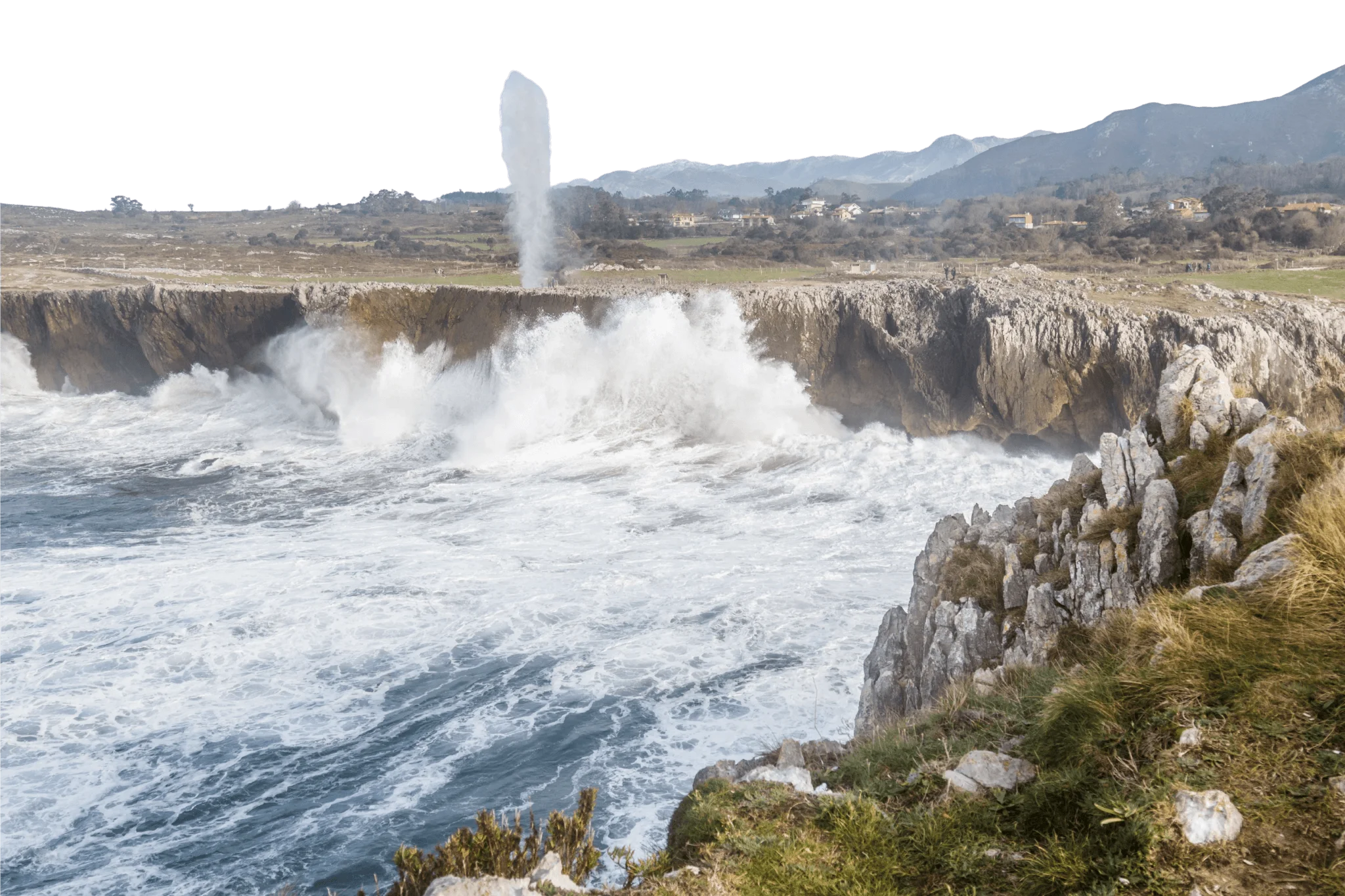
The Bufones de Pría are one of those natural phenomena you have to see at least once in your life. Marine geysers erupt from the cliffs, jets of saltwater shoot more than 20 meters into the air, and a roar reverberates deep in your chest. And all of this on the coast of Llanes, Asturias, just a stone's throw from where we are. But there's a secret many people don't know: the blowholes don't always work. This guide exists so that when you visit, you can see them in all their glory.
What are the Jesters of Pria?
Karst formations
The Bufones de Pría are karst formations in the limestone cliffs of the eastern Asturian coast, between Llanes and Ribadesella. For thousands of years, the sea has eroded the rock from below, creating a network of underground galleries and chimneys that connect the base of the cliff to the surface.
How they form: the breathing karst
When the tide rises and the waves crash against the walls, water and air become trapped in these galleries. The pressure builds until the only possible escape is upwards, through the blowholes. The result: a marine geyser that can reach over 20 meters in height, accompanied by a roar that can be heard for miles around. Hence the name: blowholes, because they blow.

Recognized by National Geographic as a "Natural Wonder of Spain"
The Bufones de Pría were declared a Natural Monument by the Principality of Asturias in 2001 and form part of the Protected Landscape of the Eastern Coast. National Geographic included them in its selection of Natural wonders of Spain that you have to see at least once in your life. Not bad at all for a cliff on the Llanes coast.
When to go to the Bufones de Pría: the key question
Blowholes aren't a fountain with a fixed schedule. They're a natural phenomenon that depends on two factors that have to coincide: the tide and the waves. Understanding this is the difference between arriving and being awestruck, or arriving and seeing nothing.
The tide: it's essential to go at high tide
For the blowholes to work effectively, you need high tide. At high sea levels, the water has greater pressure and fills the underground galleries more effectively. The jet of water then shoots out higher, stronger, and is much more spectacular.
Practical advice: arrive at least an hour before high tide to settle in and watch the action build. During peak season (July and August), arrive two hours earlier, as the parking lot fills up quickly. You can consult the Llames de Pría tide tables at [link to website/website]. tide tables before leaving home.
The waves: the factor that makes the difference
High tide is a necessary but not sufficient condition. What transforms the Bufones de Pría into the spectacle you've seen in photos and videos is the swell and the groundswell.
With calm seas, the blowholes barely expel any air. You might hear a hiss and see some bubbling, but little else. With a significant swell, the blowholes transform: the water rises violently, jets shoot skyward, and the roar reaches your chest even from a safe distance.
The best time of the year
| Time | Probability of seeing them active |
|---|---|
| Autumn and winter (Oct-Mar) | High season — is the ideal time |
| Spring (Apr-May) | Medium — depends on the waves |
| Summer (June-September) | Baja — the Cantabrian Sea is usually calm |
The best time to visit is from October to March. During these months, the Cantabrian Sea is at its most ferocious: frequent storms, a consistent swell, and blowholes in full swing. Visiting the Bufones de Pría in winter, with the storm raging and the roar of the blowholes reverberating in your chest, is one of the most magnificent experiences you can have in Spanish nature.
You can see them in summer, but you need luck. Check the surf forecast before you go.
How to get to the Bufones de Pría
The Bufones de Pría are located in Llames de Pría, in the municipality of Llanes, 10 km from Ribadesella and 22 km from the town of Llanes.
By car — A-8 exits step by step
It's the most convenient option. From the A-8 motorway:
— Coming from Gijón or Oviedo (towards Santander): take exit 312 and continue on the AS-379 towards Belmonte de Pría. Just after the town of Belmonte, turn right following the signs for Llames de Pría and Playa de Guadamía.
— Coming from Santander (towards Gijón): take exit 319, make a U-turn and take the AS-379 following the same route.
The signs to the blowholes are well marked from Belmonte. Follow them and you'll get there without any problem.
By public transport and FEVE train
The FEVE train (Oviedo-Santander line) stops in Belmonte de Pría, about 3 km from the blowholes, a 35-40 minute walk. There are also buses from Llanes and Ribadesella, although with a limited schedule. From Ribadesella, you can take a taxi to the Llames parking area (24-hour taxi service in Ribadesella: +34 985 86 15 40).
Where to park — everything you need to know
Access by car to the village of Llames de Pría is prohibited. This is not a suggestion: there are signs, and there is enforcement during peak season. Cars must be left in the designated parking areas, both of which are free.
— Llames de Pría ParkingThe main one is 1.3 km from the blowholes. From here it is a 15-20 minute walk along an asphalt road that passes by Guadamía beach.
— Garaña ParkingIf the first one is full (common in August), there's another one 1 km further on. It's also free and offers good panoramic views of the blowholes from the recreation area.
The Bufones de Pría route (PR AS-57)
Technical data
- Distance: 11.2 km circular
- Duration: 4 hours and 30 minutes with stops
- Difficulty: low, suitable for families with children
- Start and end: Llames de Pría

The step-by-step tour
From the parking lot, the paved road takes you in 15 minutes to Guadamía beach, that long and narrow sandy area carved between cliffs that at low tide is a huge esplanade and at high tide a natural pool.
From the western end of the beach, head up the dirt track towards Bramadoriu de Llames, the main blowhole field. This is where the jets reach their greatest height, and where you'll want to linger for a while if there's a storm.
The trail continues winding along the cliffs to a natural rock bridge, one of the most photogenic spots on the route. It then leads to the beaches of Villanueva and Cuevas del Mar. Before reaching Cuevas del Mar, it's worth taking a detour to see the Poza de las Grallas, a sinkhole connected to the sea whose vertical walls are a nesting site for seabirds.
The return to Llames goes through the interior, passing through La Pesa and Garaña.
What to pack and safety tips
- Footwear with non-slip soles: wet rocks are slippery
- Warm clothing and a raincoat even if the day seems nice
- Water and some food if you do the whole route
- Always maintain a safe distance: during storms, waves can crash over the cliffs and areas near blowholes are dangerous.
The Legend of the Cuélebre

The people of Asturias in the past didn't have tide tables to explain that terrifying roar coming from the ground, so they invented something much better.
Legend tells of the Cuélebre, a creature from Asturian mythology in the form of an enormous winged serpent, guardian of treasures and enchanted princesses. The Cuélebre lived in the caves of the cliffs of Pría, and its deafening wails echoed all along the coast.
One day, a young woman, fascinated by the sound, approached to investigate. The Cuélebre, upon seeing her, transformed into a handsome gentleman. But the girl's father surprised them and threw the beast into the sea. Since then, the Cuélebre has remained trapped in the underground tunnels, and its eternal roars are what we hear when the sea rages.
There are several versions of the legend, but the result is the same: the roaring of the sea is the eternal lament of a mythological creature. Much more poetic than "atmospheric pressure and limestone karst," really.
FAQ: Frequently Asked Questions about the Jesters of Pria
No. Access to the Bufones de Pría is completely free, as are the parking areas.
The trail is safe and easy. The real risk lies in getting too close to the blowholes when the sea is rough. During storms, waves can crash over the cliff and reach areas that seem safe. Always keep a safe distance and don't lean over the edge.
Yes, the route is suitable for children. The path from the parking area is flat, short (1.3 km), and mostly paved. However, keep in mind that the cliff terrain has cavities and holes in the limestone, so children must be supervised at all times near the edge. During storms and with active blowholes, the spectacle will delight them, but keep them away from the openings. It's an experience they won't forget.
Yes, but the probability is low. The Cantabrian Sea is usually calm in July and August. If you happen to be there on days with northerly winds or a swell, you might get lucky, but it's not the norm. Check the wave forecast before you go.
To see only the blowholes from the parking lot: 45-60 minutes. To do the complete PR AS-57 circular route: about 4-5 hours with stops.
Yes, there are no restrictions on dogs at the blowholes. Keep in mind: keep your dog on a leash because there's livestock (cows and sheep) along the path, and the blowholes are very powerful during storms and could frighten him if he gets too close. You'll both end up soaked if there's any action, so bring a raincoat for him too if he's sensitive to the cold.
Perfect. Guadamía beach is literally on the path between the parking lot and the blowholes. Villanueva and Cuevas del Mar beaches are less than 5 km away. If you do the entire PR AS-57 circular route, you'll pass by them all on the same journey. You can see everything in one day.
Enjoy the best experience on the Asturian coast
Apartments with sea views, an infinity pool, a private garden, and a natural setting that will captivate you from day one.